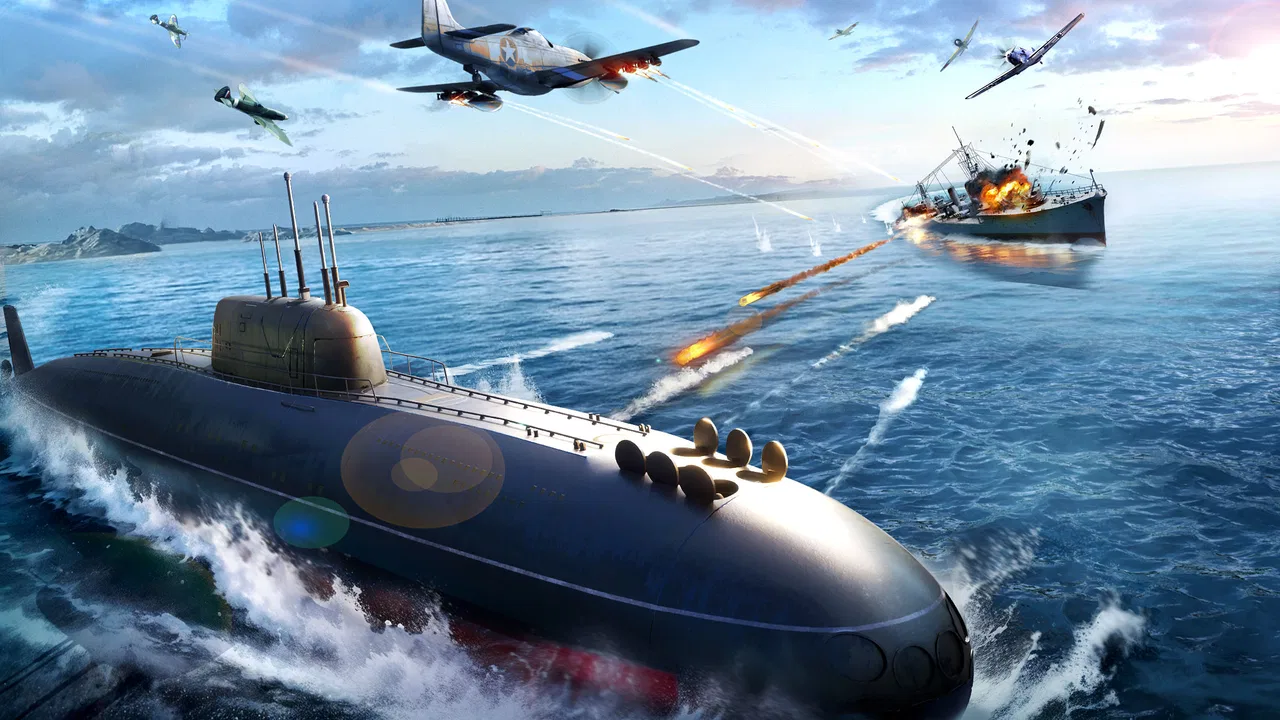
Sea War: Uboat Raid
- 4.6
- Rating
- 5.00M
- Installs
- Free
- Price
 Analysis by App-foxy
Sea War: Raid is the kind of strategy game I can open for a short check-in and then keep thinking about after I put my phone down. Its late-modern naval setting gives the battles a clear identity, while the broader structure is built around planning, improving your position, and deciding when to push forward. I found the strongest part of the experience was not simply watching ships clash, but working out which objective deserved my attention before spending time or resources on the next one.
That makes it a better fit for players who enjoy gradual progress than for anyone looking for a quick arcade battle. The game is free to start, and Tap4fun Trident Limited has made it accessible to a large audience: it has passed five million installs and holds a 4.6 average from roughly 103 thousand ratings. Those figures do not replace personal experience, but they do suggest that the basic loop is easy for many players to understand.
I spent my time treating it as a planning game rather than a pure action title. That distinction matters. If you want constant manual control and immediate victories, this may feel slower than expected. If you like setting a direction, improving your strength, and returning to see what has changed, Sea War: Raid has a more convincing reason to stay installed.
You May Also Like

 Blood Strike: 2.5 Anniversary
Blood Strike’s Loadouts Turn Every Drop Into a Tactical Gamble
A close look at Blood Strike’s custom loadouts: how fast access to signature weapons reshapes its battle royale rhythm, rewards preparation, and narrows the gap between fights.

 Pandora - Music & Podcasts
Pandora’s Music Is Easy to Start, but Harder to Recover
Pandora’s strength is its low-effort path from a seed to a station. Its weak spot is how much confidence it asks you to place in connection, setup, and quiet recovery.

 8 Ball Pool
 Is Built on Rivalries, Rematches, and Routine
A close look at the rivalries, rematches, shared routines, and unanswered safety questions that turn a quick pool match into a persistent mobile community.

 Samsung Music
’s Quiet Strength Is Playing What You Already Own
Its reach comes less from spectacle than from dependable access to a personal library. That simplicity is both the app’s strongest retention engine and its ceiling.

 AccuWeather: Weather Radar
AccuWeather Review: A Quick, Clear Forecast for Everyday Decisions
For everyday plans, the best forecast is the one you can understand quickly. AccuWeather makes rain timing, radar, and local conditions easy to act on, with a few trade-offs.

 Hill Climb Racing
Why Hill Climb Racing Still Turns Crashes Into One More Run
A tiny car, a bumpy hill and one more upgrade: Hill Climb Racing keeps resurfacing because its simple chaos makes every near-miss feel personal.
More From Our News Desk



How the first goals shape the experience
The opening stretch works best when I give myself small targets instead of trying to understand the entire game at once. The useful question is not “How do I become powerful immediately?” but “What is the next improvement that will make the following task easier?” That mindset keeps the early game from becoming a blur of buttons, rewards, and unfinished intentions.
I recommend beginning with one clear priority: strengthen the part of your force that helps you complete the next available objective, then reassess. Spreading attention everywhere can make progress feel thin. A focused upgrade path gives each return session a purpose, especially when the game presents several possible directions at once.
The late-modern naval theme also helps the early goals feel more coherent than a collection of unrelated errands. Even when the immediate task is simple, I read it as part of a larger campaign: prepare, commit, recover, and prepare again. That framing is useful because strategy games can otherwise turn into routine tapping before the player has developed a personal approach.
A realistic everyday session might look like this: I open the game during a commute, check which objective is closest to completion, collect what is ready, and decide whether the next step is worth starting before I arrive. Later, with more time, I return to handle the more demanding decision. This split-session rhythm suits the game better than trying to rush through everything in one sitting.
My first practical tip is to avoid treating every available goal as equally urgent. Some tasks are valuable because they unlock a stronger route forward; others mainly keep the activity list moving. I found it easier to judge them by asking whether completion would improve my next few decisions, not just whether it offered an immediate reward.
What makes progress feel visible
Progress is most satisfying when I can connect an improvement to a change in how I approach the next challenge. A stronger force is useful, but the real signal is whether I can now attempt something that previously looked inefficient or risky. That connection turns upgrades into decisions rather than decoration.
I also pay attention to how much of my session is spent preparing compared with acting. If preparation produces a clear advantage, the slower pace feels deliberate. If I am only repeating the same steps without a meaningful change in options, the rhythm becomes less engaging. Sea War: Raid succeeds when the player notices a new possibility after investing time, rather than merely seeing larger values.
For that reason, I suggest keeping a mental note of the obstacle that stopped you. Do not upgrade randomly after a setback. Identify whether the problem was insufficient strength, poor timing, or an overly ambitious target. Then use the next session to address that specific weakness. This simple habit makes the game feel more strategic and reduces the temptation to spend resources just because they are available.
The current version is 1.165.0, and the game runs on Android devices using version 6.0 or later. That broad compatibility is helpful for players who are not using a recent phone, although the experience will still depend on the device and how comfortably it handles longer sessions. I would keep the game updated when possible, particularly if a progression issue appears, but I would not choose a device solely for this title.
One subtle strength is that the game gives me several kinds of progress to think about at once: immediate objectives, longer-term improvement, and the gradual confidence that comes from learning what not to attempt yet. The trade-off is that these layers can compete for attention. New players may need to impose their own order instead of expecting the game to tell them which choice is best.
Where the challenge begins to rise
The difficulty curve feels more interesting when I stop judging success by whether I win every encounter. A failed attempt can still be useful if it shows that my current approach is too expensive, too early, or poorly prepared. That is a healthier form of challenge than a sudden wall that simply asks for more repetition.
Still, the game’s pacing can test patience. Strategy progression depends on waiting for improvements and choosing when to act, so players accustomed to immediate rewards may interpret normal preparation as a slowdown. I did not always find that delay equally satisfying. It works when I have a clear next milestone; it feels less rewarding when the goal is vague.
My advice is to set a stopping point before a session begins. Decide whether you are checking progress, preparing for a particular challenge, or making one important upgrade. Without that boundary, it is easy to keep browsing the same progression screens and mistake activity for advancement. A short, intentional session often feels better than a long one spent making low-impact choices.
The game is rated Teen, which is worth keeping in mind for families deciding whether it suits a younger player. I would also consider the competitive attitude of the person playing it. Someone who becomes frustrated by slow improvement or feels pressured to keep up with other players may have a harder time enjoying the planning loop, even if the naval theme appeals to them.
Compared with simpler strategy games, Sea War: Raid asks for more patience and a greater willingness to manage a campaign over time. Compared with highly detailed tactical war games, it is easier to approach on a phone because the central decisions can be made in shorter visits. The compromise is depth: players seeking precise, minute-by-minute battlefield control may find this less satisfying than a dedicated tactical alternative.
The pressure behind continued play
The free entry point is a genuine advantage. I can try the game without paying first, learn whether the naval setting and pacing suit me, and decide later whether it deserves more of my time. However, free-to-play strategy games naturally create moments where progress can feel slower than the player wants. That is where self-control becomes part of the experience.
Sea War: Raid includes in-app purchases ranging from $0.99 to $99.99 per item. I would treat those purchases as optional convenience rather than part of the basic test. The important question is not whether spending can make progress feel smoother; it is whether the game remains enjoyable when I choose to wait, plan, and accept a slower route.
My strongest recommendation is to decide on a personal spending rule before buying anything. For example, I might allow only a small occasional purchase after I have played long enough to know that the game’s core loop genuinely suits me. I would not make a purchase immediately after a frustrating setback, because that is when convenience can feel more valuable than it really is.
There is also a psychological pressure that does not require a purchase: the feeling that stopping now will waste preparation already completed. I handle that by ending sessions at a sensible checkpoint rather than waiting for a perfect result. If the next step requires a long commitment, I leave it for a time when I can play properly instead of forcing it into a distracted break.
This is where the game may not be right for everyone. Players who want a complete, self-contained campaign with no recurring pressure should look toward a premium strategy title instead. Sea War: Raid is better suited to someone comfortable with an evolving routine, where returning regularly is part of the appeal rather than an obligation.
Small habits that improve the campaign
I found three habits especially useful. First, I choose a main objective for each session and ignore attractive distractions unless they directly support it. Second, I save major decisions for when I can compare the available paths calmly, rather than making them while rushing. Third, I treat a setback as information and change one variable at a time. These habits are simple, but they make the game feel less random.
Another useful trade-off is deciding when not to chase the most ambitious target. A difficult objective may look like the best use of time, yet a smaller one can sometimes improve the position needed for the larger attempt. I prefer a route that creates two or three useful follow-up choices over a dramatic attempt that leaves me with no clear next move.
I also recommend separating “progress I can claim now” from “progress I am preparing for later.” That distinction prevents disappointment. If I know a session is mainly preparation, I judge it by whether my next attempt is better organized, not by whether I finish something impressive immediately.
These approaches are particularly helpful on a phone, where interruptions are common. The game suits a player who can return in short bursts, but it rewards having a plan before opening it. Without one, the interface can encourage passive checking rather than deliberate strategy.
Who should play and who should skip it
I would recommend Sea War: Raid to players who enjoy naval themes, gradual improvement, and making decisions across several sessions. It is a good choice if you like the feeling of turning a modest starting position into a more capable force and do not need every session to end with a major victory.
I would be more cautious recommending it to someone who dislikes waiting, recurring progression, or optional purchases in free games. It is also not my first choice for a player seeking a historically rigorous simulation or a tactical game where every unit movement is manually controlled. The late-modern setting gives the game character, but the appeal is the broader strategy loop rather than a detailed recreation of naval history.
For a casual player, the best use case is a few purposeful check-ins during the day. For a dedicated strategy fan, the attraction is finding an efficient route through the available goals and learning when patience is more valuable than immediate action. Those are different expectations, and the game serves the second group more strongly.
My verdict on the progression
Sea War: Raid holds my attention because its goals, improvements, and rising challenge are connected well enough to create a continuing sense of direction. I do not always love the slower stretches, and the free-to-play structure means I have to manage my own expectations around waiting and spending. Those are real limitations, not minor details.
Even so, the game has a clear identity and a useful middle ground between lightweight mobile strategy and more demanding war simulations. Tap4fun Trident Limited has built something approachable for short sessions without removing the need to think ahead. The best results come from focusing on one objective, learning from failed attempts, and refusing to confuse constant activity with meaningful progress.
Since it costs nothing to begin, I think it is worth trying if the setting appeals to you. Give it enough time to reveal whether its pacing feels satisfying rather than judging it by the first few tasks. My final view is positive, with one condition: the progression is rewarding when you control the tempo instead of letting the game control your attention. If that sounds like the kind of strategy routine you want, this is a credible choice in the mobile category.
FAQs for Sea War: Uboat Raid
01What is Sea War: Raid about?
Sea War: Raid is an action-packed naval strategy game where players command fleets to raid enemy waters, engage in epic battles, and manage resources. The game combines tactical planning with real-time combat, offering a rich experience for gamers who enjoy strategic challenges and maritime warfare.
02Can I play Sea War: Raid offline?
Sea War: Raid requires an internet connection to access most of its features, including multiplayer battles and live events. While some single-player modes may be available offline, the full experience, including updates and community features, is best enjoyed online.
03What are the system requirements for Sea War: Raid?
To run Sea War: Raid smoothly, Android users need at least Android 5.0 or later, and iOS users require iOS 10.0 or later. The game also demands adequate storage space and a stable internet connection to ensure seamless gameplay and updates.
04Are there in-app purchases in Sea War: Raid?
Yes, Sea War: Raid offers in-app purchases that enhance gameplay, such as special ships, resources, or premium currency. While these purchases can accelerate progress, they are optional, and players can enjoy the game without spending real money.
05How does multiplayer work in Sea War: Raid?
In Sea War: Raid, multiplayer mode allows players to compete against others worldwide in real-time battles. Players can join alliances, participate in raids, and strategize with teammates. This mode is a key feature of the game, providing competitive and cooperative gameplay experiences.
Pros
- Engaging real-time naval battles.
- Stunning graphics and sound effects.
- Variety of ships to customize.
- Smooth and intuitive controls.
- Frequent updates with new content.
Cons
- Requires constant internet connection.
- In-app purchases can be costly.
- Some ships take time to unlock.
- Occasional server connectivity issues.
- Limited storyline depth.

Sea War: Uboat Raid
Gallery